



Your Green Card Can Be Taken Away. Here Is What Happens When It Is.
I have had clients come into my office who have been in this country for twenty years.
They came here legally. They got their green card. They built something. A business, a family, a home. They paid taxes, coached their kids' soccer teams, went to church on Sundays.
And they are sitting in immigration court fighting deportation because of a conviction.
A domestic violence charge. A drug offense. Something that felt, at the time, like a problem they handled and moved on from. Something their criminal defense attorney told them to plead guilty to because it was the fastest way through.
What their criminal defense attorney did not tell them was what that plea would mean under federal immigration law.
This is one of the most painful conversations I have in my practice. Not because the law is complicated, though it is. Because the people sitting across from me did not know the ground was moving under their feet until they were already falling.
A Green Card Is Not Permanent Protection
Most people understand that undocumented immigrants can be deported. What fewer people understand is that lawful permanent residents can be deported too.
A green card gives you the right to live and work in the United States indefinitely. It does not make you immune from removal. Under federal law, certain criminal convictions trigger deportability regardless of how long you have held your green card, how long you have lived here, or how many U.S. citizen family members you have.
The main categories of crimes that can put a green card holder in removal proceedings are aggravated felonies, crimes involving moral turpitude, drug offenses, domestic violence convictions, and firearms offenses.
That list is broader than most people realize, and the definitions under immigration law do not always match what people expect based on how things work in state court.
Why State Court Outcomes Do Not Protect You
This is the gap that gets people.
Criminal defense attorneys and immigration attorneys are doing two different jobs. A criminal defense attorney is trying to get the best outcome in the criminal case. That might mean a plea to a reduced charge, probation instead of jail time, a deferred adjudication. Those outcomes can look like wins in state court. Under federal immigration law, they can still be convictions with full deportation consequences.
A domestic violence misdemeanor in Texas. A drug possession charge that resulted in probation. A DUI where someone was injured. These are not abstract legal categories. These are the kinds of cases that land people in immigration court.
And because criminal defense attorneys are not always immigration attorneys, they do not always know, or warn their client, that the plea they are recommending has immigration consequences. By the time the client finds out, the conviction is already on the record. USCIS and immigration enforcement can see it. What happened in state court does not disappear from the federal record.
If you are a green card holder and you are facing any criminal charge, you need an immigration attorney involved before anything is resolved in criminal court. Not after. Before. Because the decisions made in that criminal proceeding will follow you into any future immigration matter.
What Happens When a Green Card Holder Is Placed in Removal Proceedings
When immigration authorities determine that a green card holder has committed a deportable offense, they issue a Notice to Appear. That document places the person in removal proceedings before an immigration judge.
At that point, the question is no longer whether you have a green card. The question is whether you can keep it.
The options available at this stage depend entirely on the nature of the conviction. Some convictions trigger mandatory detention, meaning the person is held while the case is pending. Some convictions eliminate most or all forms of relief. A green card holder convicted of an aggravated felony, for example, is barred from almost every form of relief the immigration courts can offer. The path from that point to deportation is short.
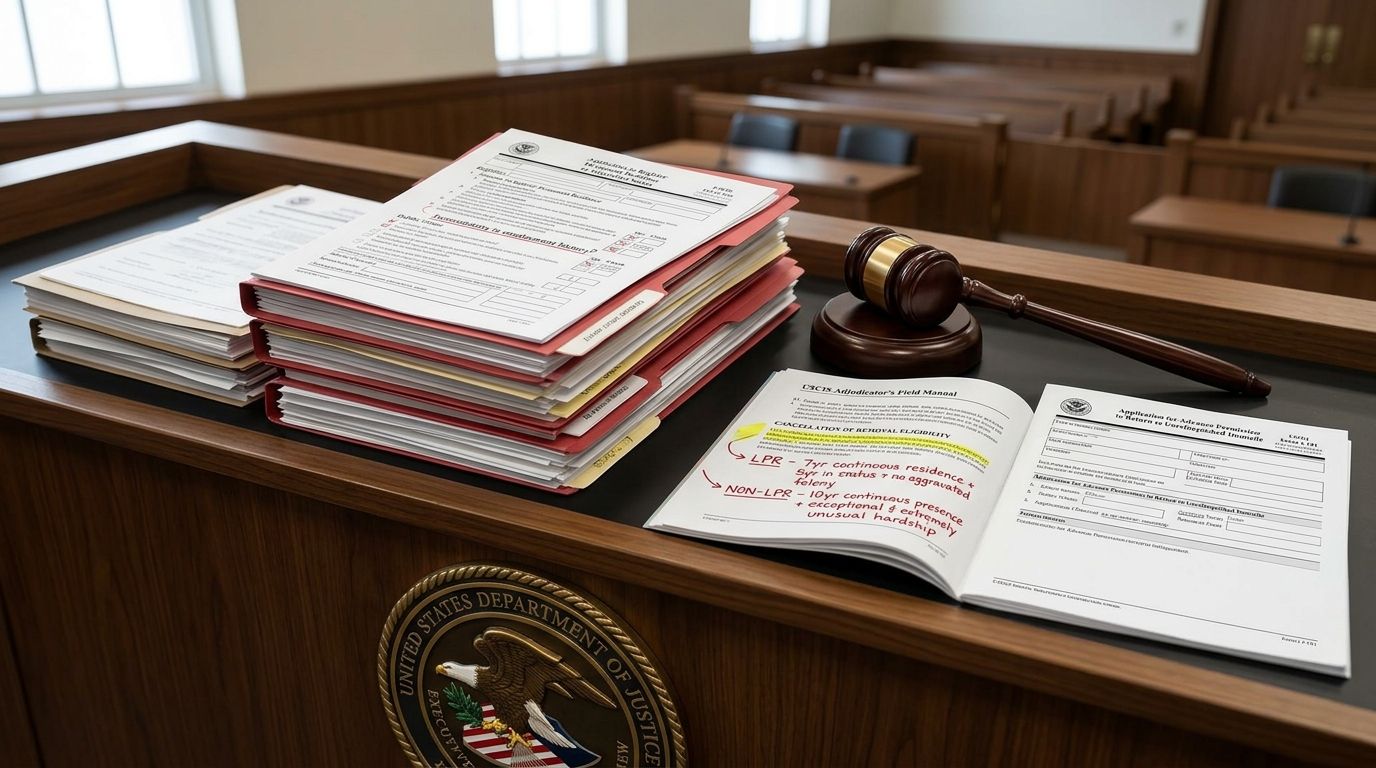
For people who have not been convicted of an aggravated felony, one option may remain: cancellation of removal for lawful permanent residents, filed on Form EOIR-42A.
What EOIR Form 42A Cancellation of Removal Actually Is
Cancellation of removal for lawful permanent residents is a form of relief that allows a green card holder in removal proceedings to ask an immigration judge to cancel the removal order and allow them to keep their permanent resident status.
It is not automatic. It is not a right. It is a request for discretionary relief, meaning the judge has to be persuaded that you deserve to stay.
To even file the application, you have to meet three statutory requirements.
First, you must have been a lawful permanent resident for at least five years at the time you file. Not five years in the country. Five years as a green card holder.
Second, you must have resided continuously in the United States for at least seven years after being admitted in any immigration status. This seven-year clock can start before you got your green card, as long as you were admitted lawfully. But the clock stops when you are served with a Notice to Appear, or when you commit certain offenses. That stopping point, called the stop-time rule, matters enormously. If the government can show the clock stopped before you hit seven years, you do not qualify.
Third, you must not have been convicted of an aggravated felony. This is an absolute bar. If you have an aggravated felony conviction, you are not eligible for cancellation of removal under any circumstances. There is no waiver. There is no discretion. The door is closed.
What Counts as an Aggravated Felony Under Immigration Law
This is where people are often surprised, and the surprise is not usually pleasant.
The definition of aggravated felony under federal immigration law is not the same as the definition under state criminal law. The immigration definition is broader and covers a wider range of conduct than most people expect.
Under the Immigration and Nationality Act, aggravated felonies include murder, rape, drug trafficking, firearms trafficking, sexual abuse of a minor, money laundering, fraud or tax evasion involving more than ten thousand dollars in losses, and theft or violent crimes where a sentence of one year or more was imposed, even if the sentence was suspended and the person never served a day in jail.
That last point is the one that catches the most people off guard. A sentence of one year, even if fully suspended, even if the person served no time, can qualify the offense as an aggravated felony under immigration law. What the criminal court did with the sentence is not the test. What the sentence was is the test.
The Crimes That Most Commonly Bring Green Card Holders Into Removal
Based on what I see in practice, the convictions that most frequently put green card holders in removal proceedings are drug offenses, domestic violence convictions, and crimes of moral turpitude.
Drug offenses are particularly unforgiving under immigration law. Almost any drug conviction, other than a single offense for possession of thirty grams or less of marijuana for personal use, can make a green card holder deportable. Drug trafficking convictions are aggravated felonies and close the door to cancellation entirely. Even a simple possession conviction for other substances can trigger removal proceedings.
Domestic violence convictions are their own category under the Immigration and Nationality Act. A domestic violence conviction can make a green card holder deportable whether or not it would be considered an aggravated felony by any other measure. And the immigration definition of domestic violence is broad, covering not just physical violence but conduct that involves threats or fear of harm in a qualifying domestic relationship.
Crimes of moral turpitude are harder to define because the term is not precisely defined anywhere in the statute. Courts have interpreted it to cover crimes involving fraud, dishonesty, theft, and intent to harm. A single crime of moral turpitude committed within five years of admission and carrying a potential sentence of one year or more can be a basis for removal. Two or more crimes of moral turpitude at any point can be a basis for removal.
If You Qualify to Apply, You Still Have to Win
Getting past the eligibility requirements for cancellation of removal does not mean you win the case. It means you are allowed to ask.
Once the application is filed, the case goes to a merits hearing before an immigration judge. The applicant testifies. Witnesses testify. Evidence is presented. The judge weighs positive factors against negative factors and makes a discretionary decision.
Positive factors include length of residence in the United States, family ties to U.S. citizens and permanent residents, employment history, community involvement, evidence of rehabilitation, and hardship to family members if the person is removed.
Negative factors include the criminal conviction itself, the circumstances of the offense, whether there are additional violations, and whether the person has shown genuine accountability for what happened.
The judge is looking at the whole picture. A conviction that falls short of an aggravated felony does not mean cancellation will be granted. It means cancellation can be considered. The outcome depends on the strength of what is presented and how the judge weighs it.
The Hardship Standard
One thing that comes up in every cancellation case is hardship. Cancellation of removal is partly about the person facing removal, but it is also heavily focused on the impact on their family.
The law asks whether removal would result in exceptional and extremely unusual hardship to a U.S. citizen or permanent resident spouse, parent, or child. That language, exceptional and extremely unusual, sets a high bar deliberately. Hardship is expected in any case where a family member is deported. The question is whether the hardship in this specific case goes significantly beyond that baseline.
This is where the case is often built or lost. Documenting a child's medical needs, a spouse's dependence, a parent's circumstances, the education and life disruption that removal would cause. These are facts that have to be developed, supported with evidence, and presented persuasively to the judge.
What Happens If Cancellation Is Denied
If the immigration judge denies the application, the person has thirty days to appeal to the Board of Immigration Appeals. An appeal that is filed on time generally stays the removal order while the appeal is pending. Common grounds for appeal include failure to properly consider evidence, incorrect application of the law, and changed circumstances.
If the Board of Immigration Appeals denies the appeal, the case may be appealed to a federal circuit court, though the grounds for federal court review in immigration cases are limited.
If all appeals are exhausted and relief is denied, the removal order becomes final and the person is subject to deportation.
Act Immediately When a Notice Arrives
One thing people do not fully grasp until they are holding one of these documents is how little time they have.
A Notice to Appear starts the removal proceedings clock. Response deadlines on immigration notices can be as short as thirty days. Thirty days to retain an attorney, pull documentation, and file a legal response. Miss that window and a removal order can be entered without you ever having the chance to present your case.
The moment a notice arrives, the clock is already running. Not when you decide to take it seriously. From the date on that document. Call an attorney the same day.
Protecting Your Status Means Not Giving Anyone a Reason to Question It
I am going to say something direct here because I think people need to hear it.
I see a lot of preventable situations in my practice. Not just the serious convictions that trigger removal proceedings. The smaller things too. The decisions people make without thinking through the immigration consequences. The risks people take because they assume their green card protects them from everything or because they did not realize a particular thing was a problem.
It is not stupidity. It is not bad character. It is a lack of information. And that is fixable. But it has to be fixed before something goes wrong, not after.
So here is what I want green card holders to take seriously.
Do not travel outside the United States after a criminal conviction without talking to an immigration attorney first. Some convictions that would not trigger removal inside the country become grounds for denial at the border when you try to return. Green card or not.
Do not assume that because something was handled in state court it does not exist for immigration purposes. It exists. USCIS and immigration enforcement have access to criminal records. Old charges, dismissed cases, deferred adjudications, things that felt like they were taken care of years ago can surface in an immigration review.
Do not file anything with USCIS, whether it is a naturalization application, a travel document, or anything else, without knowing whether something in your history could create a problem. Some applications require you to disclose your full criminal history. Filing without understanding how that history will be evaluated can turn a routine application into a removal case.
Do not overstay travel outside the country. Accruing unlawful presence as a green card holder after a trip abroad creates a different set of complications than people expect.
And if someone in your household, a spouse, a child, a family member, is facing a criminal matter, understand that immigration is part of that picture even if their name is not the one on the notice.
The clients I can help the most are the ones who come to me before there is a crisis. We can talk through their specific situation, identify any risks in their record or circumstances, and make a plan that keeps them protected. That conversation costs fifty dollars and an hour of your time.
The clients I wish I had seen sooner are the ones who come in holding a notice with a thirty-day deadline and a conviction on their record that nobody flagged when it happened.
I am not here to judge the decisions people made before they knew better. I am here to make sure they know better going forward.
If You Are a Green Card Holder Reading This
If you or someone in your family is a lawful permanent resident and you are facing a criminal charge of any kind, please talk to an immigration attorney before anything is resolved in criminal court.
If you have already been convicted and you have received a Notice to Appear, call us. The deadline in that document is real. What happens early in removal proceedings affects what is available later. An attorney needs to look at your case while there is still time to build a defense.
If you have a conviction on your record and you have not yet received any immigration notices but you are worried about what it means for your status, a consultation is the right first step. Knowing where you stand now is better than finding out when it is already an emergency.
About the Author
Arzoo R. Connor is a licensed immigration and estate planning attorney and the founding attorney of ARC Legal Services in Fort Worth, Texas. She came to this country as a child and has spent her career helping immigrant families understand and protect their legal status.
She handles removal defense, family-based immigration, adjustment of status, naturalization, and estate planning for clients across the DFW area. To schedule a consultation, please call 469-200-0158.